Digital PEWS
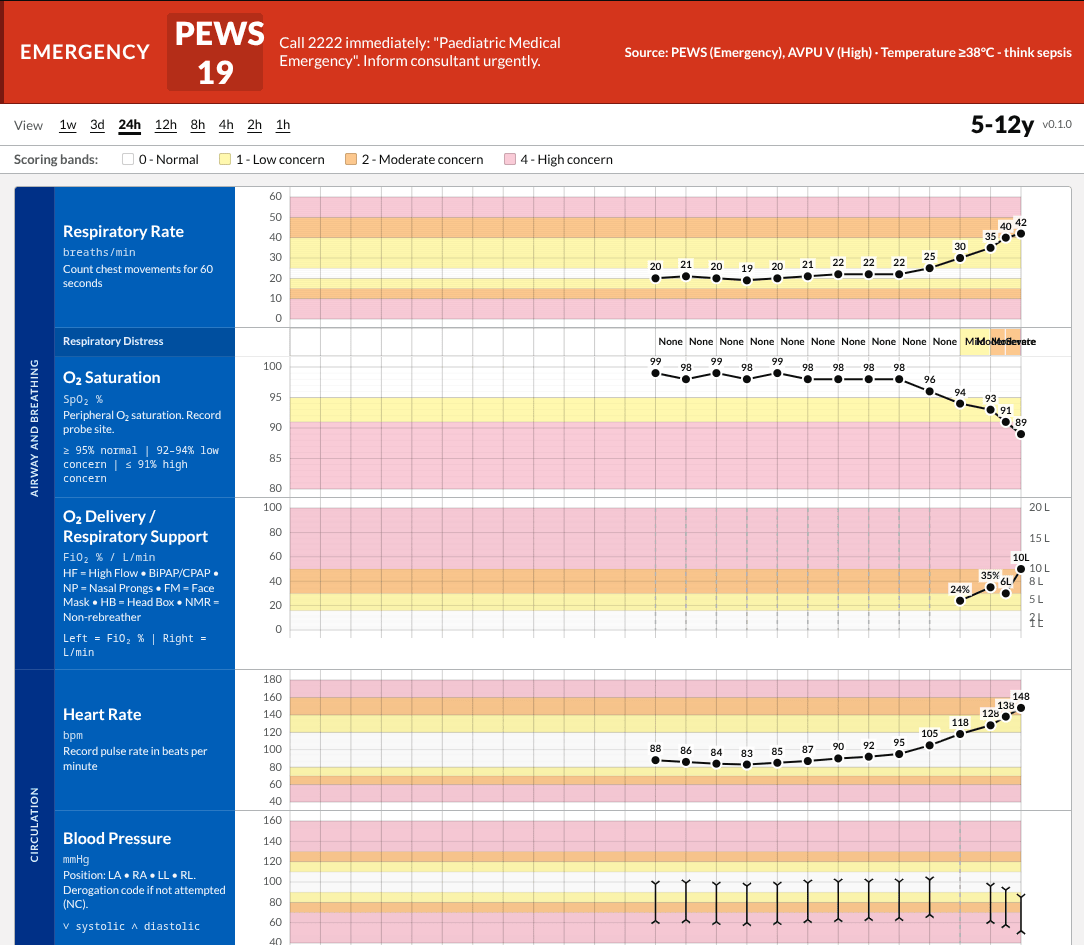
Digital PEWS is an open-source charting and scoring component for the NHS National Paediatric Early Warning System (NPEWS) observation chart. It calculates NPEWS scores from observations recorded in your electronic patient record (EPR) and draws the chart clinicians recognise, inside the system they already use. Patient data stays in your EPR.
It is an OHTF Foundation Project. The work began at the Royal College of Paediatrics and Child Health (RCPCH); OHTF continues it independently following RCPCH's indefinite pause of its PEWS work, with existing attribution retained.
Contact the Digital PEWS team View the demo Source code
Why it matters
The National Paediatric Early Warning System (NPEWS) gives NHS hospitals one shared way of recording a child's observations and recognising when they are becoming seriously unwell. A common chart only helps if it looks and scores the same wherever a child is cared for, yet each EPR supplier builds its own version, or a trust falls back on paper.
Digital PEWS is one open, inspectable implementation of the chart that any EPR can host. Every trust using it sees the same chart and the same scores, and every improvement made for one trust is available to all of them.
How it works
- A component, not a new system. Digital PEWS is a bounded scoring and charting component. Your EPR keeps ownership of observation entry, patient identity, records, audit, alerts and escalation workflow.
- EPR-agnostic. It runs as a SMART on FHIR app, using the FHIR R4 standard to read observations from the host EPR, and can also be embedded directly in a web page or application.
- Plain web technology. Plain HTML, CSS and JavaScript, with no framework and no build step, so it is simple to host, review and maintain.
- Open and auditable. The source code is published under LGPL-3.0-or-later and the documentation and clinical content under CC BY-SA 4.0. Its scoring rules are defined in a machine-readable specification, traced to the NHS NPEWS source material and checked by automated tests.
Key facts
| Lifecycle status | Foundation Project, Incubating |
| Current version | 0.1.0, a development snapshot with an experimental interface |
| Clinical release | No clinically approved release has been designated. Not approved for direct patient care until supplier and deployer clinical safety assessment is complete. |
| Intended use | Calculate NPEWS scores from supplied observations and draw the chart, embedded in a governed clinical system |
| Licence | Code: LGPL-3.0-or-later. Documentation and clinical content: CC BY-SA 4.0. The NHS NPEWS specification and reference chart remain the property of NHS England. |
| Maintainer | OHTF Digital PEWS project maintainers |
| Clinical Safety Officer | Not yet appointed for the component; required before clinical deployment |
| Medical device | Intended-purpose and classification assessment not yet completed |
| Clinical safety documentation | SAFETY.md: initial hazard identification, transferred controls and known gaps |
| Standards | NHS NPEWS observation chart, FHIR R4, SMART on FHIR |
| Contact | pews@openhealthtechnology.org |
Why is all this public? See why we publish so much.
Support for NHS organisations
OHTF works with NHS trusts and other providers to take Digital PEWS from open-source component to a governed deployment in their own clinical system.
Integration
Hands-on help connecting Digital PEWS to your EPR, including Oracle Health (Cerner Millennium) and other SMART on FHIR capable systems: app registration, launch configuration, FHIR mapping of your observation data, and testing against your environment, working alongside your EPR team and supplier.
Clinical safety
Digital PEWS publishes its clinical safety documentation openly in the project's SAFETY.md. OHTF provides the component's safety case material and works with your Clinical Safety Officer on your DCB0160 assessment of the integrated system. The component has no clinically approved release yet; completing that work for a deployment is part of what this service delivers.
Training
Training for clinical, digital and EPR teams: how the chart and scores work, what the component does and does not do, configuration, and the safety controls your organisation owns.
Ongoing support
An annual support agreement at a fixed price agreed in advance, so there are no surprise costs. It covers a named support contact, agreed response times, help with updates and new releases, and advice as the NPEWS specification and your EPR change.
Open by default
Paid support never makes Digital PEWS less open. Improvements made during support work go back into the open project unless they are specific to your deployment, so every organisation using it benefits. See OHTF's open-source commitment.
Talk to us
To discuss integration, training or a support agreement for your organisation, email the Digital PEWS team at pews@openhealthtechnology.org.
To report a security vulnerability, use the security policy, not this address.